
Latest from GRIIT
News, events, and stories from across our network.




Creating Real Change Together
Every number represents lives touched, voices amplified, and futures protected
10+
School-based workshops delivered
5
Public-facing workshops delivered
1,300+
Students Engaged
300+
Public & professional participants
6
Case studies completed
6
Case studies in development
9
Research outputs completed
3
Outputs in development
6
Completed projects
6
Active projects
1
Active PhD projects


Founded on Expertise, Driven by Impact
An interdisciplinary research network addressing digital challenges through evidence and collaboration
The Gender Equity Research and Inclusive Innovation in Technology Network (GRIIT) is an interdisciplinary research network based at Aston University, advancing research, policy, and practice on gender equity, cybersecurity, responsible AI, and inclusive digital innovation. GRIIT brings together academic expertise, applied research, and cross-sector collaboration to address pressing challenges in the digital age, with a strong emphasis on societal impact and inclusion.

Founder & Director
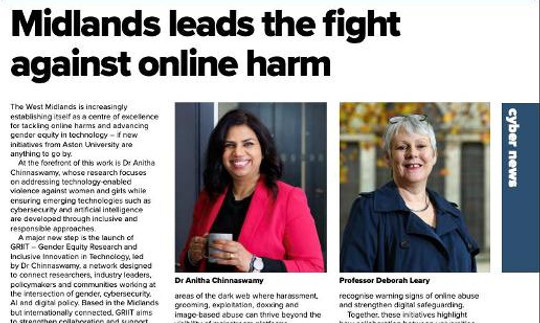
Dr Anitha Chinnaswamy
Innovation must be accountable to the societies it serves. GRIIT brings research, policy, and practice together to ensure that emerging technologies are not only advanced, but equitable, inclusive, and trusted.
GRIIT was founded by Dr Anitha Chinnaswamy to strengthen the connection between cyber security research, governance, and real-world practice. Created in response to the growing need for collaborative, evidence-led solutions, the network brings together academia, industry, and policy to address emerging cyber risks.
GRIIT focuses on translating research into practical impact — advancing organisational resilience, workforce development, and inclusive innovation across the cyber ecosystem.
Research That Moves Beyond the Lab
Translating evidence into action across sectors and communities
Interdisciplinary Research & Education
GRIIT undertakes interdisciplinary research, education, and engagement at the intersection of gender, technology, cybersecurity, and responsible innovation.
Academic Research Meets Applied Practice
The Group's work combines rigorous academic research with applied practice, policy engagement, and co-creation to address complex digital and societal challenges.
Gender & Cybersecurity Research
Our activities span gender and cybersecurity research, responsible and ethical AI, digital safety and online harms, and inclusive innovation and skills development.
Cross-Sector Collaboration
We work closely with industry, law enforcement, government, civil society, and educational institutions to translate research into practical tools, training, and evidence-based insights.
Education & Capacity Building
Through education, capacity building, and public engagement, GRIIT supports inclusive skills pipelines and empowers underrepresented communities.
Responsible Technology Development
We contribute to the development of equitable, accountable, and socially responsible technologies.
2024-2025
CyVAWG
Cyber Violence Against Women and Girls
CyVAWG was a multidisciplinary research and engagement project examining the prevalence, forms, and impacts of technology-facilitated abuse against women and girls.
Funded by Innovate UK and delivered in collaboration with law enforcement, policymakers, and civil society, the project combined survivor-centred research, regional crime data analysis, and public engagement to strengthen awareness, policy understanding, and practical responses to cyber violence. Key outputs included community and public workshops, anonymised case studies, and the development of a survivor-informed toolkit to support prevention, reporting, and digital resilience.
2023-2025
CyberKali
Gender-Inclusive Cybersecurity Education and Skills Development
CyberKali was an education-led initiative addressing gender and diversity gaps in cybersecurity by providing inclusive, experiential learning opportunities for girls and young women.
Funded by the Department for Science, Innovation and Technology, the project delivered hands-on Capture the Flag events, mentoring, and engagement with industry role models to increase confidence, skills, and awareness of cybersecurity education and career pathways. Although completed prior to the establishment of GRIIT, CyberKali generated foundational evidence and practice insights that informed GRIIT’s later focus on education, empowerment, and inclusive skills pipelines.
2025-2026
CyberDIVA
A Forensic-Led Investigation of Cyber Violence Against Women and Girls
CyberDIVA is an ongoing forensic-led research and innovation project investigating cyber violence against women and girls within hidden and illicit online environments.
Funded by Innovate UK, the project integrates digital forensics, responsible AI, and co-creation methodologies to develop tools, evidence, and policy-relevant insights. Current activities include co-creation workshops with law enforcement, NGOs, and secondary schools in Birmingham, alongside public engagement initiatives, culminating in practical resources and forensic innovations to support prevention, detection, and survivor-centred responses.
2025-2027
InnovaCyBridge
Bridging Cybersecurity, Innovation, and Entrepreneurship
InnovaCyBridge is a European research, innovation, and education initiative designed to strengthen cybersecurity capacity across higher education institutions by integrating deep-tech cybersecurity training with innovation, entrepreneurship, and industry engagement.
Funded under the EIT Higher Education Initiative, the project brings together universities, industry partners, startups, and innovation ecosystems across Europe to address critical skills gaps and accelerate innovation-driven growth.
2026
SCUDO
Strengthening Capacity to Understand and Disrupt Online Abuse
Funded by Aston University’s Aston Impact Fund, SCUDO (Strengthening Capacity to Understand and Disrupt Online Abuse) addresses the £66 billion annual harm caused by cyber-violence against women and girls. Working with Forensic Pathways, West Midlands Police, Hellenic Police, Valencia Police and the Hellenic Forensic Association, the project analyses abuse patterns across open and dark web sources.
SCUDO will co-design a practical digital-safety toolkit, deliver specialist training to 40–50 frontline practitioners, and produce an evidence-based policy brief for UK and EU stakeholders. By strengthening detection and cross-border coordination, SCUDO improves safeguarding practice and policy coherence internationally.
2026
VAWG-AIE
Cyber Violence Against Women and Girls: Evaluating AI in Social Media Governance
Launched in January 2026, this fully funded PhD project at Aston Business School examines how artificial intelligence is used by social media platforms to detect and address Cyber Violence Against Women and Girls (CVAWG). While AI-driven moderation systems aim to reduce online harassment, abuse, and gender-based hate speech, they also raise concerns around bias, misclassification, and the reinforcement of existing inequalities.
Using a socio-technical systems framework and a mixed-methods approach, including computational content analysis, case studies, and stakeholder interviews, the project critically evaluates the effectiveness, limitations, and unintended consequences of AI content moderation.
The research contributes to interdisciplinary debates on gender, technology, and online safety, generating practical recommendations for platforms and policymakers to ensure AI systems are both technically robust and socially accountable.
2025-2026
CLEARVAWG
Contextual Linguistic & Explainable AI Research for VAWG
CLEARVAWG examines the early-stage feasibility of gender-harm-aware AI methods for digital evidence triage. Funded by the Test and Learn Fund (Round 3) 2026, and delivered in collaboration with Forensic Pathways and UK policing partners.
Using a fail-fast, fail-safe design and synthetic/public data, the project tests the interpretability, trustworthiness, and bias risks of integrated approaches combining large language models, noise reduction, slang and coded-language handling, and forensic-linguistic frameworks. The findings will inform evidence-based stop/go decisions for future policing innovation, contributing to more accountable and transparent AI tools in the context of violence against women and girls.
2023-2025
HARMONY
Hidden abuse research and mapping of online misogyny ecosystems.
HARMONY investigates hidden and unmoderated online environments associated with technology-facilitated violence against women and girls, analysing over 70 million indexed dark-web pages and an established corpus of 844,000 forum posts.
Funded by the UKRI Safer Streets Fund / Violence Against Women and Girls Challenge, and delivered by Aston University in partnership with Forensic Pathways Ltd.
The project integrates AI semantic search, behavioural clustering, and network analysis to produce the first large-scale analytical map of misogynistic discourse ecosystems. Outputs include policy briefings, practitioner-ready evidence, and an Aston-hosted practitioner roundtable aligned with urgent Online Safety and safeguarding priorities.
Knowledge That Protects
Survivor-informed resources to recognize, prevent, and respond to cyber violence
CyVAWG Toolkit
Comprehensive guide for understanding and responding to cyber violence against women and girls. Includes case studies, digital safety strategies, and support pathways.
Working Alongside Partners Across Sectors
Our research and impact are strengthened through collaboration with government agencies, universities, law enforcement, industry leaders, and advocacy organizations working together to create safer digital spaces. If your organization shares this mission, let's work together.


